Kids Jiu Jitsu in Breaux Bridge, Louisiana

Strong, Confident Kids. Built Through Jiu Jitsu.

Jiu Jitsu for kids 4 and up in Breaux Bridge. Games they actually look forward to, real technique underneath them, and classes small enough that one coach knows your kid's name. No contract and no belt test fees. If you can't point at something that's changed, you get every dollar back.

Claim a Founding Spot
Classes start in January. Twelve founding spots.

Twelve founding spots. Classes start in January. Your rate locked for life. No contract. No belt fees. See the spots →

Is This Your Kid

You Already Know
Something Isn't Clicking.

You do want your kid getting good at something, and Jiu Jitsu will handle that part. But it's usually not what brings a parent to a page like this. You're here because of something you've watched happen, more than once, and you don't know what to do about it.

  • They quit everything. Baseball, soccer, karate for two months. You've got the cleats in the garage to prove it.
  • Somebody shoved them at school and they just stood there.
  • They're so sweet you worry about it. You have actually thought the words "kids are going to walk all over them."
  • They're bouncing off the walls by four o'clock and there is nowhere in the house to put it.
  • The iPad comes out and they're gone. Taking it away is World War Three.
  • And you are not signing a year contract for something they'll quit by March.

None of that means something is wrong with your kid. It means they haven't found the thing yet.

Why The Other Stuff Didn't Work

You've Already Tried
Most Of This.

Most parents who end up here have a garage full of receipts. It usually goes something like this.

Team sports. You bought the glove, the cleats, the bat bag. They picked grass in right field and sat until the last two innings while the coach's kid played every one. Sometimes it's the wrong fit for the kid. Sometimes the roster is just too deep for them to get any real reps. Either way you end up paying for a season your kid mostly watched.

Other martial arts. A year contract for a five year old. Belt tests every couple of months at sixty dollars a pop. Three belts later you couldn't name one thing they actually learned. Twenty-five kids, one instructor shouting over them, and your card kept charging two months after the contract ended.

Dance, gymnastics, cheer. The first six weeks are great. They love the outfit and they show you every move in the living room. Then it turns into a fight to get them in the car. A lot of these programs are built around the recital or the competition team, so the kids who were already good get the attention and everybody else learns the routine from the back row. Your kid figures out pretty fast which group they're in. You end up with a two hundred dollar costume worn twice and a kid who's a little more sure they're just not good at things.

Talking to them about it. Just ignore them. Just be confident. Use your words. Dad said toughen up. None of it moved a single inch, and it never will, because you cannot talk confidence into a kid. They don't have a knowledge problem. They already know what they're supposed to do. They've just never once done it and come out the other side.

Screen limits and sticker charts. Timers on the iPad, chore charts on the fridge, a sticker for every good day. It works for about three days. Then the timer turns into a negotiation, the chart falls behind, and you're right back where you started, only more tired. That's not bad parenting. It's that a chart can only manage the behavior, it can't touch the reason for it. A kid with a tank full of energy and nowhere to put it doesn't need a better chart. They need somewhere to spend it that gives something back.

Every one of those failed for one of three reasons. It didn't work on the actual problem. It didn't fit your kid. Or it was built to take your money and never had to prove it changed anything. That's the whole list.

How This Actually Works

Why It Sticks
When Nothing Else Did.

Nothing here is complicated. It comes down to a handful of choices about how the room is run, and together they are the reason this tends to work on kids that other things didn't work on.

  1. A Small Room, On Purpose. Classes cap at six kids for now. A smaller space means less attention to split, and that is the entire point. Your kid can't disappear into a back row and nobody gets carried along in the middle of a crowd. It runs a lot closer to a private lesson than to a class of twenty-five.
  2. They Learn To Work Through Hard Things. This is the part that does the real work. Jiu Jitsu hands a kid a problem they can't solve on the first try, then gives them another go at it a minute later, and another one after that. Something doesn't work, they adjust, they try it again, and eventually it clicks. It's a safe place to be stuck, and being stuck is where kids grow. Nobody can talk a child into believing they can handle hard things. They have to be handed a few and get through them, and that's what a class here is.
  3. No Punches. No Kicks. Ever. This is grappling. There's no striking in it at all, so nobody is getting hit in the face and your kid isn't coming home practicing a right hook on their little brother. What they learn instead is control. How to stay calm with somebody on top of them, how to hold a position without hurting their partner, and how to shake hands and reset when the round is over. It's hard, physical work built on patience and respect for the kid across from them. If you were worried you were signing them up to learn to hit people, you're not.
  4. The Same Coach Every Class. Kids don't open up for a stranger. They open up for the adult who remembers what they were stuck on last Thursday and asks them about it tonight. That only happens when it's one coach the whole way through, instead of a rotating schedule. Over a few months I learn which kids need pushing, which ones need to be left alone for five minutes, and which ones say they're fine when they're not. None of that shows up on a first impression.
  5. Belts And Stripes Are Free. Forever. No testing fee, no promotion fee, no belt ceremony package. Not this year and not in three years. Your kid gets a white belt put in their hands on day one, and every stripe after that costs you nothing. If they earn it, they get it.
What Changes

Not Overnight.
But You'll See It.

Nobody can promise you a different kid in thirty days, and anybody who does is selling you something. Here is what actually shows up, usually somewhere in the first couple of months.

  • They get put on their back, lose the round, and get up without checking your face first to see how they're supposed to feel about it.
  • Fewer meltdowns when things don't go their way.
  • They shake an adult's hand and look them in the eye while they do it.
  • They stick with something hard past week three, which they have never done.
  • They know what to do with their body when another kid grabs them, so standing there frozen stops being the only option.
  • They're worn out at eight o'clock in a way the iPad has never once managed.

That is the actual product. The Jiu Jitsu is just the tool that builds it.

The Two Classes

Little Skeeters
and Skeeters.

Two age groups, both in the gi, starting in January. Each class caps at six kids for now. And yes, they're named after the state bird. Small, fast, and impossible to get off you once they land.

Ages 4 to 6

Little Skeeters

It looks like games, because at this age it has to be. Balance, coordination, and focus get built through play, and underneath every game is a piece of Jiu Jitsu they'll still be using in ten years. For a four or five year old the win is simple. Learn to fall down, get back up, keep your hands busy, and listen to a grown-up who isn't your parent.

Schedule announced soon
Starts January · Six spots
Ages 7 to 13

Skeeters

Same room, more teeth. There are still games and it's still the part kids look forward to, they're just Jiu Jitsu specific now and there's a lot more real technique attached to them. Kids build on the fundamentals, learn positions by name, drill them with a partner, and train live at the end of every class. This is where technique starts turning into something they could actually use, and where getting stuck and working out of it does the most for them.

Schedule announced soon
Starts January · Six spots

Membership is unlimited, so every class I add later is open to every founding kid at no extra cost. As the gym grows I'll open more classes and split these into tighter age brackets, so a seven year old isn't training next to a twelve year old forever.

Twelve Spots.
Then It's A List.

Twelve founding spots, and they don't come back. Once they're taken, a spot only opens when a kid leaves. The twelve lock in a rate that never goes up, and the price climbs for everybody after them.

Claim a Founding Spot
No contract. Full refund before day one.
Who's Coaching Them

The Coach.

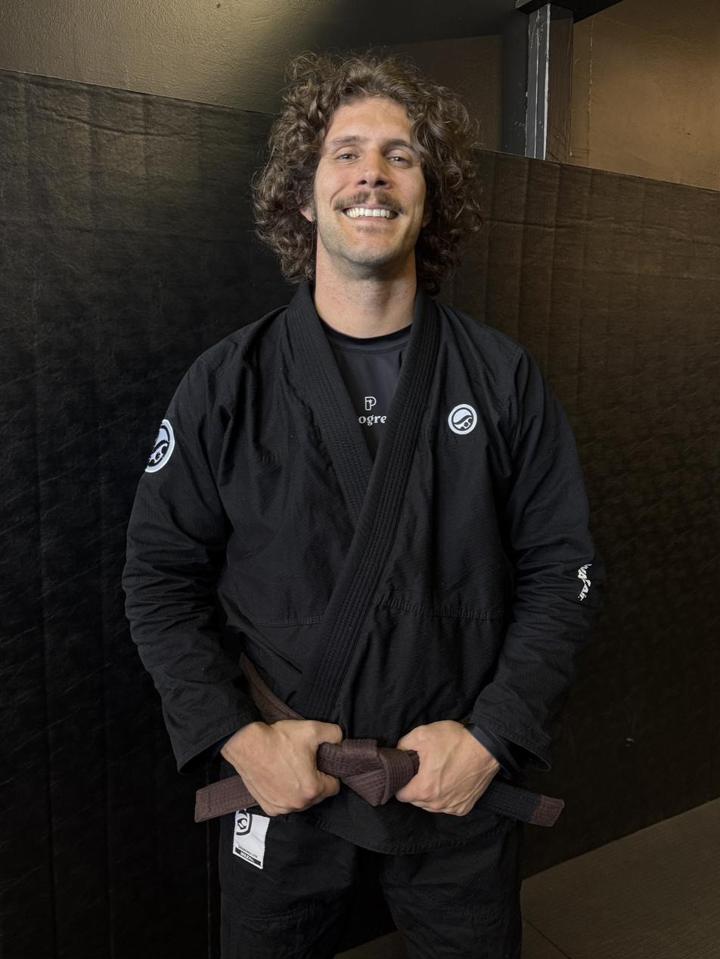
Canaan Frederick, brown belt and founder of Basin Jiu Jitsu

Canaan Frederick. I started training in 2019, a few months after my father passed. I needed something hard to do. Something that asked everything of me and gave me a way to be in my body instead of my head. Seven years later I haven't stopped.

I've had the pleasure of training under some amazing coaches. Tim Credeur, Jules Bruchez, Josh Artigue, and Heath Henry. I also spent 2022 and 2023 training at Easton in Denver and the surrounding areas, which was an incredible experience, and I came home better for it. I've competed here and there, but I've always had a deeper love for the daily training.

I started coaching in mid-2024 with a class of 3 to 5 year olds. Everyone warned me it would be brutal but it was the opposite. The kids loved me, I loved them, and somewhere in the middle of all that I figured out I was built for this. I took on adult fundamentals shortly after, with everyone from total beginners to a 70-something-year-old in his first gi. The thing people kept telling me was that they actually understood what was being taught, and that stuck.

I'm building Basin with my brother Caleb and my wife Sophia. Breaux Bridge is home. I went to school here at St. Bernard and Breaux Bridge High, played sports at both, and I've coached at both since.

What People Say

Don't Take
My Word For It.

How To Join

Pick A Spot
And Lock Your Rate.

Three ways to claim one of the twelve spots. All three hold your place, lock your rate for life, and cover your first month.

Founding Spot
$99today
Then $125 a month. Locked for life.
  • One of twelve founding spots
  • Gi and white belt, in their hands day one $89 value
  • First month of training free $125 value
  • Two friend passes, so a friend can come try it out with them $50 value
  • 90 days of season freeze, every year $375 value
  • No belt test fees or promotion fees, ever
Total value $639
Claim This Spot
Founding Family
$1,497today
A full year, paid up front. Nothing monthly after.
  • One of three founding family spots
  • A full year of training. Pay for ten months, train twelve $1,500 value
  • One parent trains free for the same year, unlimited $1,500 value
  • Two gis and a belt $178 value
  • Kickoff Session and Check-In Session $170 value
  • A Basin t-shirt $25 value
  • Six friend passes $150 value
  • 90 days of season freeze, every year $375 value
Total value $3,898
Claim This Spot

Whichever one you pick, it's $125 a month after that for unlimited training, and that rate is yours for as long as your kid keeps training. It never goes up. Prices will keep climbing for everyone who joins after these twelve. No annual fee, no belt test fee, no promotion fee, ever.

A Word On Founding Plus

Founding Plus is $150 more than the Spot and puts $334 more in your hands, but the math isn't the reason to take it. The reason is the two private lessons. The first one happens before day one. Most kids spend their whole first class deciding whether they're safe instead of learning anything, and a kid who already spent a session on that mat with me walks in and starts training. The second one comes at thirty days, once I actually know your kid, so we can work on whatever they're stuck on and you can see exactly where they're at. The second gi earns its keep too, because one gi means you're doing laundry on a deadline between classes.

Take A Season Off

Every spot includes up to 90 days of freeze a year. Baseball season, football season, a move, a rough few months. You pay nothing while you're out, there's no penalty and no re-enrollment fee, and your spot and your locked rate are exactly where you left them when you come back.

Got Two Kids?

Add a second kid for $89 a month instead of $125, for as long as they train, locked the same way the $125 is. There's a $99 registration that covers their gi and belt. Worth knowing up front: the second kid takes one of the twelve spots.

Belts Are Earned, Not Bought

Every stripe and every belt is free, forever. No testing fees, no promotion fees, and no belt that shows up because a payment went through. Kids earn them by showing up consistently, carrying themselves well on the mat, understanding what they've been taught, and actually using it when they train. I'll also ask you what you're seeing at home, because the good habits count off the mat too. When a stripe comes, your kid knows they earned it, and that's why it means something.

If It Doesn't Work

You Don't Pay.
Either Way.

The 90 Day Guarantee

Before day one: change your mind for any reason and I refund every dollar. Just let me know and I'll take care of it. Quick, simple, and hassle-free.

After training starts: bring your kid to twenty classes in their first ninety days. If you can't point at one thing that's different in how they carry themselves, tell me and I refund everything you've paid. They keep the gi and the belt.

Questions

Real Questions,
Real Answers.

What age groups do you have?

Two right now. Little Skeeters is ages 4 to 6 and Skeeters is 7 to 13. Each caps at six kids and starts in January. The class schedule is coming soon, and founding families hear them first. As the gym grows I'll open more classes and split those into tighter age brackets, so kids are always training alongside others close to their own age and size. If your kid is in high school, they can train in the adult classes.

Is it safe? I don't want my kid getting hurt.

Yes. Jiu Jitsu is a controlled, technique-based martial art, and that's the whole reason it's one of the few things a kid can practice at full speed without getting hurt doing it. Classes are structured, instruction is age-appropriate, and kids are supervised the entire time they're on the mat.
There's no striking, so the injuries you're picturing from football or karate aren't on the table. Kids learn from their first night to tap the second something is uncomfortable, and the round just resets, no shame in it. They progress at their own pace, I stop anything reckless on the spot, and I don't put a forty pound kid across from a seventy pound kid.

I don't want my kid learning to hit people.

They won't. There is no punching or kicking anywhere in this. Jiu Jitsu is about controlling somebody without hurting them, which is exactly what you want a nine year old to have instead of a right hook. Kids who train Jiu Jitsu tend to be the last ones to escalate anything, because they already know how a physical situation ends and don't need to find out.

Can siblings train together?

If they're in the same age group, yes, they'll be in the same class. If they're not, they'll be in different ones, and honestly that's usually better for both of them. A second kid is $89 a month instead of $125, locked the same way, with a $99 registration that covers their gi and belt. Just know the second kid takes one of the twelve spots.

Does my child have to compete?

Not at all. Competition is optional here and it always will be. I'll encourage a kid to challenge themselves, but Jiu Jitsu is about learning and getting better at their own pace, and plenty of kids train for years and never step on a competition mat. Nobody gets pushed into it and nobody gets treated differently for sitting it out.

They play another sport. Will they fall behind?

No, and I'd rather they play. Kids who do more than one sport move better than kids who only play one, and that's not a nice thing I'm saying, it's just true. That's exactly what the 90 day freeze is for. Take the season off, pay nothing while you're out, and your spot and your rate are exactly where you left them.
Claim a Founding Spot

Claim Your
Kid's Spot.

Twelve founding spots. Once they're taken, a spot only opens when a kid leaves. Send your info and I'll text you back.

You can wait and hope it works itself out. Sometimes it does. Or your kid starts in January, and by spring they're a different kid than the one you're worried about right now.